
OVERWHELM. When Everything Feels Like Too Much, By Sally Race; Clinical Hypnotherapist.
OVERWHELM. When Everything Feels Like Too Much
By Sally Race; Clinical Hypnotherapist.
You know that feeling when your brain has 47 tabs open… and one of them is playing music but you cannot find which one?
That!
Overwhelm is not just “being busy”. It is that heavy, foggy, slightly panicky state where even small tasks suddenly feel weirdly enormous. The washing up feels offensive. Emails feel personal. And deciding what to have for tea feels like you have been asked to solve world peace.
If this sounds familiar, you are very normal. And more importantly, you are not broken.
Let’s talk about what is actually going on.
What Overwhelm Really Feels Like
For many people, overwhelm creeps in quietly before it properly announces itself.
You might notice:
- Your brain feels foggy or scattered
- You keep starting things but not finishing them
- Small decisions feel strangely difficult
- You feel tired but wired at the same time
- You find yourself procrastinating… then beating yourself up about it
- Your to do list makes you want to lie down in a dark room
Emotionally, overwhelm often brings a lovely cocktail of:
- Irritability
- Anxiety
- Pressure
- Guilt for “not getting things done”
It’s a pain, isn’t it?
What Overwhelm Actually Is (From a Brain Point of View)
Overwhelm is not a personal failure. It is a nervous system response.
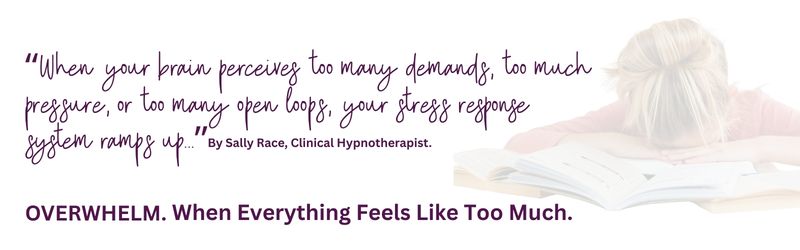
When your brain perceives too many demands, too much pressure, or too many open loops, your stress response system ramps up. The thinking part of your brain (the prefrontal cortex, if we are being fancy) becomes less efficient, while the emotional and survival parts become louder.
In simple terms:
Your brain goes into mild survival mode.
And when that happens:
- Clear thinking drops
- Prioritising becomes harder
- Memory gets patchy
- Everything feels more urgent than it actually is
So when you are overwhelmed and thinking,
“Why can’t I just get on with it?”
It is not laziness. It is neurology.
The good news is that the brain is very capable of calming back down when given the right signals of safety and structure.
Practical Ways to Reduce Overwhelm
You do not need a complete life overhaul. Small, targeted shifts often work surprisingly well.
- Shrink the List (Ruthlessly)
Overwhelm loves an endless to do list.
Instead of looking at everything, ask:
What are the THREE most important things today?
Not twelve. Not “everything ideally”. Three.
Your brain handles finite far better than infinite.
- Externalise the Noise
When everything is swirling in your head, it feels bigger than it is.
Do a quick brain dump:
- Write everything down
- No organising yet
- Just get it out of your head and onto paper
This alone can reduce mental load because your brain no longer has to keep holding it all.
For this, I like to get a huge piece of paper and some coloured pens. I list all my roles and under that all the responsibility’s / tasks of that role. When finished I prioritise what I want to keep and what I want to dump. What I can not do, what I can delegate and what is important and essential that only I can do (this is a biggie, sometimes we convince ourselves that it’s better if we do it, when actually we could give the task to someone else).
- Use the “Next Tiny Step” Rule
When something feels overwhelming, the step you are looking at is usually too big.
Instead of:
❌ “Sort the office”
Try:
✔ “Pick up the papers on the desk”
Momentum reduces overwhelm. But momentum only starts when the step feels almost laughably doable.
- Calm the Nervous System First
If your body is in stress mode, productivity hacks will only get you so far.
Quick resets that genuinely help:
- Slow, longer exhales than inhales
- A short walk outside
- Stretching your shoulders and jaw
- Stepping away from screens for five minutes
You are not wasting time. You are helping your brain come back online.
- Reduce the Hidden Pressure
Many people I work with are not just overwhelmed by tasks. They are overwhelmed by their own internal pressure.
The constant:
- “I should be coping better”
- “I’m so behind”
- “Why can everyone else manage?”
That inner commentary pours petrol on the overwhelm fire.
Sometimes the biggest shift comes from helping the brain feel safe enough to stop running in the background.
When Overwhelm Keeps Coming Back
If you find yourself stuck in cycles of overwhelm, there is often something deeper going on:
- chronic stress patterns
- anxiety loops
- perfectionism
- people pleasing
- nervous system stuck on high alert
This is where willpower alone usually falls short.
Because overwhelm is not just about time management. It is about how your brain and body are responding to pressure.
Don’t Know Where to Start?
If you are reading this and thinking:
“I know what I should be doing… I just cannot seem to do it.”
You are exactly the kind of person I help every week.
At Derbyshire Hypnotherapy, I work gently but effectively with the patterns driving overwhelm, helping your nervous system settle and your mind feel clearer and more in control again.
You do not have to white knuckle your way through it.
If you would like some support, you are very welcome to book a free initial consultation and we can have a calm, no pressure chat about what is going on for you.
Sometimes the first step is simply not doing it all on your own.
Feeling calmer starts with small changes. And your brain is far more changeable than you might think.
Sally is with us at the Bridge Centre on a Wednesday, FREE consultations are available!
To find out more about Sally head over to her bio: https://bridgenaturalhealth.co.uk/sally-race-clincial-hypnotherapist/